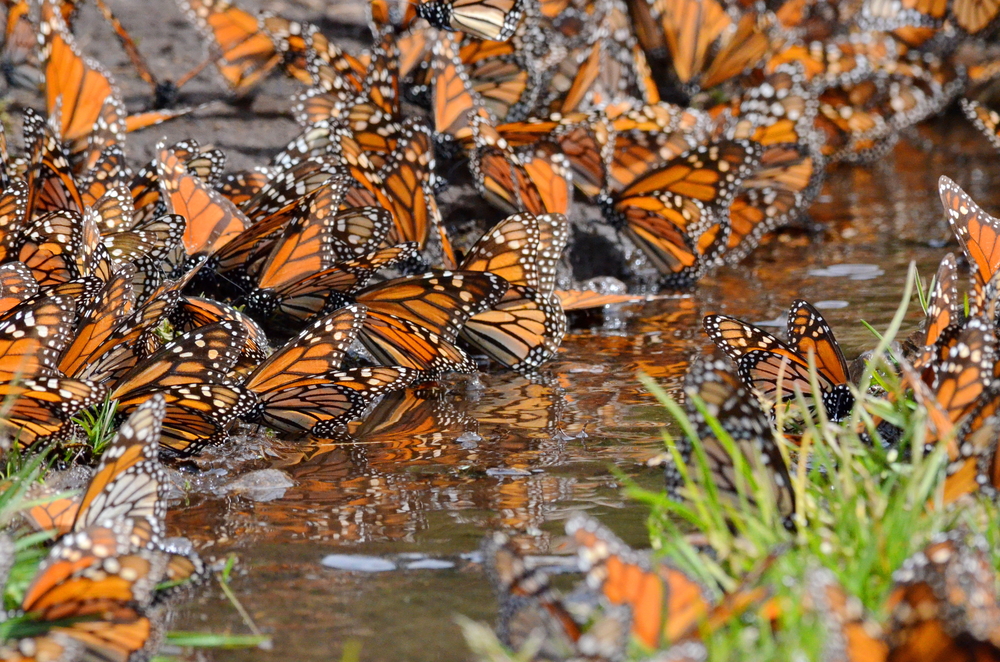
Over this holiday season, there’s a glimmer of optimism in San Luis Obispo County. It takes the shape of a famous orange-and-black striped butterfly that lives in towering eucalyptus and Monterey cypress trees all along the coast. According to preliminary statistics shared by local volunteer coordinator Jessica Griffiths, Xerces Society for Invertebrate Conservation employees and volunteers counted more than 129,000 western monarch butterflies in the county in November.
According to Xerces Society data, this is the most counted in San Luis Obispo County in more than 20 years; in 1998, there were roughly 182,000 counted. The figures give some researchers hope that the western monarch butterfly population is on the mend after dropping to dangerously low levels a few years ago, leading some to believe the creature was on the edge of extinction. “It’s really encouraging,” Griffiths said of the most recent numbers.
Monarchs are on the rise statewide
The county’s high numbers of overwintering monarch butterflies reflect a statewide trend. The Xerces Society reported that more than 300,000 of the insects were counted during its annual Thanksgiving count, which took place this year from Nov. 12 to Dec. 4. This is a significant increase over data acquired in 2020 when counters discovered only 2,000 of the butterflies overwintering across the entire state.
Griffiths said it’s difficult to say why there are more monarch butterflies. Part of this is due to the fact that there are more groves being counted: According to her, 55 locations were assessed in San Luis Obispo County this year, up from 51 the previous year. This figure has been steadily climbing as residents keep a lookout for the insects and report them to the Xerces Society.
According to the Xerces Society, the county’s most extensive overwintering groves include the Pismo Beach Monarch Butterfly Grove along Highway 1, Pecho Road near Los Osos, the Morro Bay Golf Course, the Fiscalini Ranch Preserve, and hundreds of individual estates. Griffiths believes the Xerces Society’s activities are critical in determining how many monarch butterflies migrate to San Luis Obispo County and other coastal locations in California each winter before flitting away to breed. “We need accurate data to really target restoration efforts,” she said. “And right now, I think we’re seeing it’s working — we’re seeing them rebound.”
What does this mean for monarch butterfly conservation?
Despite the recent comeback, scientists, like Griffiths, are quick to temper their excitement, since the monarch butterfly population is still in danger of extinction. The International Union for Conservation of Nature recently declared monarch butterflies to be endangered, with climate change and habitat damage identified as two main factors in the species’ decline.
In California, around 235,000 western monarch butterflies were counted in 2014. That same year, the Xerces Society and other conservation organizations petitioned the US Fish and Wildlife Service to include monarch butterflies on the federal Endangered Species List. The federal government is still considering the petition. The California Department of Fish and Wildlife has listed monarch butterflies as endangered and vulnerable. According to the agency, this means that the insects cannot be handled, removed from the wild, or taken for scientific or propagation reasons without a permit.
How can local communities help boost monarch butterfly populations?
The Xerces Society and other conservation groups are planting milkweed and nectar plants and safeguarding overwintering and summer habitats from destruction.
Griffiths suggested that individuals living in inland regions at least five miles from the shore, such as San Luis Obispo, Atascadero, and Templeton, plant milkweed plants to feed the insects. Woolypod, California, heartleaf, narrow-leaf, and showy milkweed are examples of native milkweeds in California.
Those who live along the coast or near overwintering places should grow nectar plants that bloom in the autumn, winter, and spring to help feed the butterflies while they overwinter and fly away to reproduce. According to the Xerces Society, native nectar plants that monarchs enjoy include goldenrod, sunflowers, blue-dicks, seaside fleabane, coyote brush, mules-fat, desert-broom, rabbitbrush, goldenbush, mimic heather, manzanita, and willow.